Self-Revising AI: MIT's Leap in Scientific Discovery

Most machine learning systems are trapped inside the mathematical boxes their creators built for them. When faced with a scientific problem, a typical model can search for answers only within a pre-defined hypothesis space, optimizing parameters it was told to care about. MIT researchers Fiona Y. Wang and Markus J. Buehler (from the MIT Laboratory for Atomistic and Molecular Mechanics) have published a breakthrough category-theoretic framework that allows agentic AI to autonomously identify when its reasoning schema is inadequate, tear down its own walls, and expand its conceptual vocabulary to make genuine scientific discoveries.
Key Takeaways
- The Discovery Modality: The framework formally distinguishes Discovery (autonomous schema expansion) from Retrieval (database lookup) and Search (optimization within a fixed space).
- Category Theory as Scaffolding: Using typed copresheaves and functors, the system maps reasoning schemas as mathematical structures that can be dynamically enlarged.
- Rigorous Verification: By employing left Kan extensions, the AI can mathematically transport old observations into new representational regimes, ensuring consistency without losing past evidence.
Beyond Retrieval and Search
In the current wave of agentic design, we often confuse search with discovery. A system that optimizes a molecule’s weight by adjusting parameters is doing excellent high-speed search, but it is not discovering new concepts. As we explored in AI as a Lab Partner, the true promise of AI in science lies in forming new hypotheses, not just calculating permutations.
To achieve this, an agent must be capable of structural self-revision. When an agent encounters anomalous data that cannot be explained by its current worldview, it must not simply discard the data as noise. Instead, it must expand its internal database schemas to accommodate the new reality—a process that mirrors the autonomous self-improvement loop we are beginning to see in advanced reasoning agents.
The Categorical Framework for Self-Revision
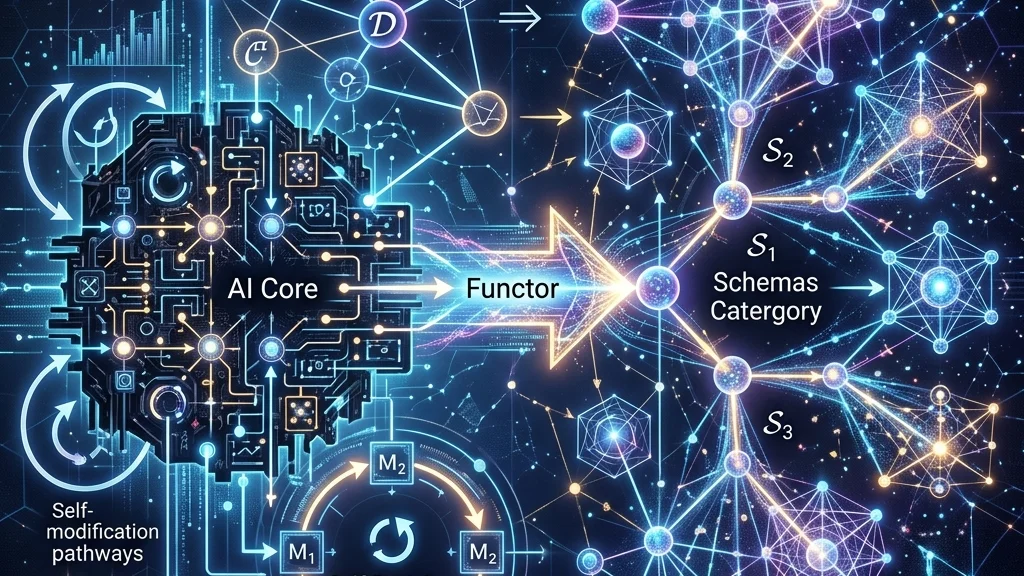
In their paper, Self-Revising Discovery Systems for Science: A Categorical Framework for Agentic Artificial Intelligence, Wang and Buehler utilize category theory to govern this transition. By representing the agent’s knowledge structures as typed copresheaves (which act as database schemas), the system can mathematically define how reasoning regimes change.
graph TD
    A[Observation / New Data] --> B{Reasoning Schema}
    B -->|Case A: Fits Existing Schema| C[Standard Search & Optimization]
    B -->|Case B: Schema Inadequate| D[Structure Revision via Category Theory]
    D --> E[Enlarge Schema: Typed Copresheaves]
    E --> F[Left Kan Extension: Transport Old Evidence]
    F --> G[Measure Residual / Validate Consistency]
    G --> H[Genuine Scientific Discovery]
When the system determines that the current schema is insufficient, it maps the old schema to an enlarged schema via a functor. To ensure that this transition does not break existing knowledge or fabricate facts, the agent calculates a left Kan extension. This construct transports previous evidence and observations into the new representational regime, leaving a measurable “residual” which serves as a quantitative metric of the novelty introduced.
Practical Implementations: Builder/Breaker and CategoryScienceClaw
The authors demonstrated the framework’s power using two distinct systems:
- Builder/Breaker: This model was tasked with modeling protein mechanics. Controlled by a Minimum Description Length (MDL) gate, the system revised its world model to discover “mode-conditioned compliance laws” under extreme stress, expanding its mechanical concepts autonomously.
- CategoryScienceClaw: An extension of the ScienceClaw platform, this system used proof-carrying knowledge graphs to discover complex rules governing anisotropic fiber-network stiffness, translating raw physical evidence into abstract categorical relationships.
Stated Limitations and Theoretical Challenges
Despite its mathematical elegance, the MIT framework faces practical hurdles before wide-scale deployment:
- Computational Complexity: Calculating left Kan extensions over highly dimensional, real-world knowledge graphs is computationally intensive and introduces latency.
- Bootstrapping the Initial Schema: The system still requires human experts to define the initial, foundational schema before the agent can begin its autonomous revisions.
- Sensitivity of the MDL Gate: The Builder/Breaker model’s self-revision threshold is highly sensitive to Minimum Description Length hyperparameter tuning, which can occasionally lead to over-eager schema growth or rigid resistance to change.
Business and Enterprise Implications
The transition to self-revising architectures will reshape how industries approach complex datasets:
- Accelerated Materials & Pharma R&D: Instead of running millions of trial-and-error simulations, agents can autonomously propose new physical classes of materials and drug targets by re-schema-ing their biological models.
- Dynamic Enterprise Knowledge Bases: Modern database architectures are notoriously fragile when schemas change. Category-theoretic agents can enable databases to auto-evolve, dynamically adapting schema designs as new unstructured data types are ingested.
- Provable Audit Trails: In safety-critical sectors, understanding how AI teaches itself is a major regulatory hurdle. The Kan transport mechanism provides a machine-complete, mathematically verifiable lineage showing exactly why and how an agent updated its reasoning structure.
Final Thoughts
The work of Wang and Buehler signals a departure from brute-force scale. By providing agentic AI with a mathematical mechanism to rewrite its own representational rules, we move closer to systems that do not just calculate our world, but actively help us conceptualize it. The future of scientific AI is not in larger models with fixed boundaries, but in elegant, self-revising structures that know when to break their own rules.