Are You Agent-Ready? Optimizing for AI Agents


Within the next twelve months, the primary visitor to your website will not be a human looking at a screen, but an autonomous AI agent acting on their behalf.
Whether it is a shopping agent searching for the best B2B software vendor, a research assistant summarizing product documentation, or an automated workflow agent making API calls, your digital presence must adapt. If your site is only built for human eyes, you are becoming completely invisible to the next generation of internet users.
Key Takeaways
- The Rise of the Machine User: AI agents are transitioning from simple text synthesizers to active web browsers, negotiators, and buyers.
- Beyond Traditional SEO: Optimization now requires machine-readable standards like
llms.txt, RFC-style API catalogs, and granular bot access controls. - Secure Agent Integration: Standardized discovery protocols, Model Context Protocol (MCP), and secure OAuth authentication endpoints are essential to allow agents to interact with your services.
- HarrisonAIX’s 100/100 Score: We tested our own infrastructure against the latest Agent-Readiness benchmarks and achieved a perfect “Agent-Native” rating.
The Evolution of the Web: From Humans to Agents
The transition from traditional SEO to Generative Engine Optimization (GEO) was the first warning sign. GEO taught us how to optimize content to be summarized and cited in answer engines like Perplexity and SearchGPT. But the agentic era demands much more than just summaries.
We are moving from a web of information retrieval to a web of delegated execution. In this new model, autonomous software systems need to navigate your site, comprehend your offerings, verify your credentials, call your APIs, and make purchases.
To satisfy these machine users, websites must adhere to new standards of structure, clarity, and machine-readability.
What Does an “Agent-Ready” Site Look Like?
Being “Agent-Ready” means your site is built to be easily navigated and acted upon by LLM-driven agents. Based on current industry proposals and security frameworks, a comprehensive optimization checklist is structured around four primary pillars:
| Pillar | Technical Standard | Primary Purpose |
|---|---|---|
| 1. Discoverability | Custom robots.txt + Content-Signal | Granular bot access permissions and licensing control |
| 2. Content Structure | /llms.txt + Semantic HTML | Providing high-density, context-rich summaries for LLMs |
| 3. API & Auth Discovery | /.well-known/api-catalog | RFC-style linksets pointing to OpenAPI specifications |
| 4. Identity & Permissions | /.well-known/oauth-authorization-server | Secure OAuth2.0 discovery endpoints for machine trust |
1. Discoverability & Granular Bot Control
Classic robots.txt rules are a blunt instrument. As we continue to develop sophisticated agent architectures, we need more nuanced ways to communicate with crawlers.
HarrisonAIX implements a new, forward-thinking standard called Content-Signal inside our robots.txt to instruct models on exactly what they can do with our data:
User-agent: GPTBot
Content-Signal: ai-train=no, search=yes, ai-input=no
Disallow: /admin/
This specifies that AI search engines (like ChatGPT Search) are allowed to crawl and cite our content (search=yes), but the models are strictly prohibited from using our proprietary intellectual property for training data (ai-train=no) or as raw user-prompt context (ai-input=no) without licensing agreements. Refer to the OpenAI GPTBot Documentation for standard base crawlers.
2. Content & The /llms.txt Standard
If your content is buried in complex layouts, LLMs will struggle to parse it, wasting expensive token contexts. The emerging /llms.txt standard (developed in response to the growing usage of Small Language Models (SLMs)) solves this by providing a clean, markdown-based summary of your site’s structure, services, and core contact details at the root level. For more details, see the llms.txt Specification.
3. API, Auth, MCP & Skill Discovery
If an agent wants to perform a high-value task—like running a search query, checking stock, or creating a booking—it should not scrape your HTML. It should use your APIs.
To enable this, your site must provide standardized discovery paths:
- API Catalogs: Using
/.well-known/api-catalogto point to your OpenAPI specification (e.g.,openapi.json), letting the agent know exactly what tools are available. - OAuth Security: Standardizing authentication discovery at
/.well-known/oauth-protected-resourceand/.well-known/oauth-authorization-serverprevents the “Shadow Agent” security risks outlined in The Agentic Control Plane. - Model Context Protocol (MCP): Implementing
/.well-known/mcp/directories to allow agents to discover custom servers and skills, building on the framework we explored in our analysis of Cloudflare MCP Servers.
Case Study: HarrisonAIX’s Agent-Native Infrastructure
To prove the efficacy of these protocols, we put HarrisonAIX through the industry’s leading Agentic Readiness Audit. The results show exactly how technical standards translate into a highly accessible machine-readable experience:
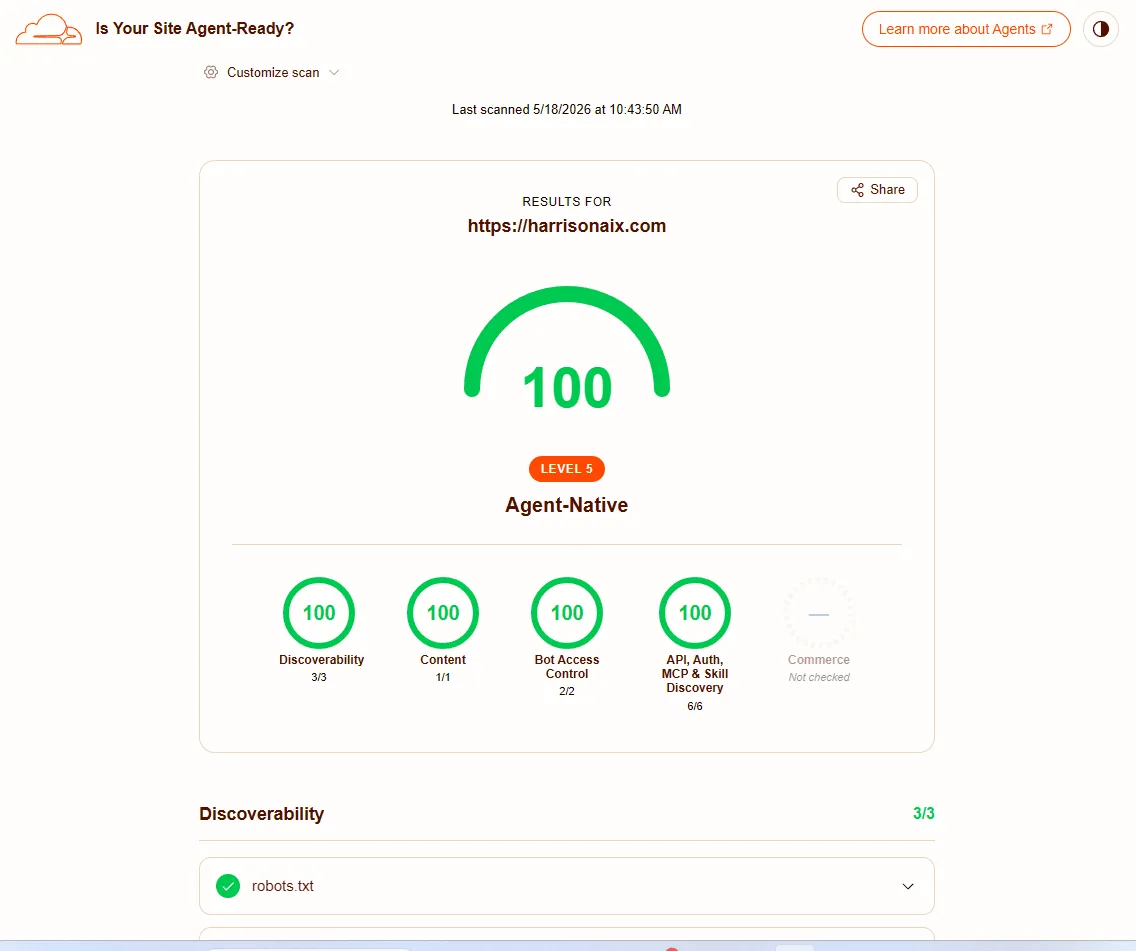 HarrisonAIX achieved a perfect 100/100 “Level 5: Agent-Native” audit score across discoverability, content indexing, bot access control, and API authorization discovery.
By implementing structured Content-Signal headers, a comprehensive llms.txt map, and standardized RFC-compliant .well-known discovery files, we have established our digital presence as a fundamental, highly reliable source of truth in the AI agent ecosystem.
The Ultimate Horizon: Agentic Commerce
When buying agents can query APIs, authenticate their users, and execute transactions programmatically, the entire e-commerce funnel changes. Traditional web design—focused on optimized conversion funnels for human clicks—becomes secondary to Agentic Commerce.
Instead of routing a customer through complex, multi-page checkout forms, enterprise infrastructure will communicate through secure, unified protocols. Businesses that support autonomous, secure machine checkouts will capture the massive, emerging market of machine-directed purchases. You can explore how this functions in our detailed overview of Agentic Checkout Orchestration and UCP.
Final Thoughts: Prepare for the Agentic Shift
The transition to a machine-navigated web is not a distant prediction—it is happening today. The websites that adapt early will establish strong model-citation authority and capture massive automated traffic flows, while those that delay will see their visibility decline as humans increasingly rely on agents to filter the web.
Audit your site’s machine-readability today. The agents are browsing—make sure they can understand and interact with what you have to offer.
Ready to transition your enterprise to an agent-friendly architecture? Reach out to the team at HarrisonAIX to secure, optimize, and future-proof your digital presence.