The LLM Faithfulness Gap: Reasoning vs. Action

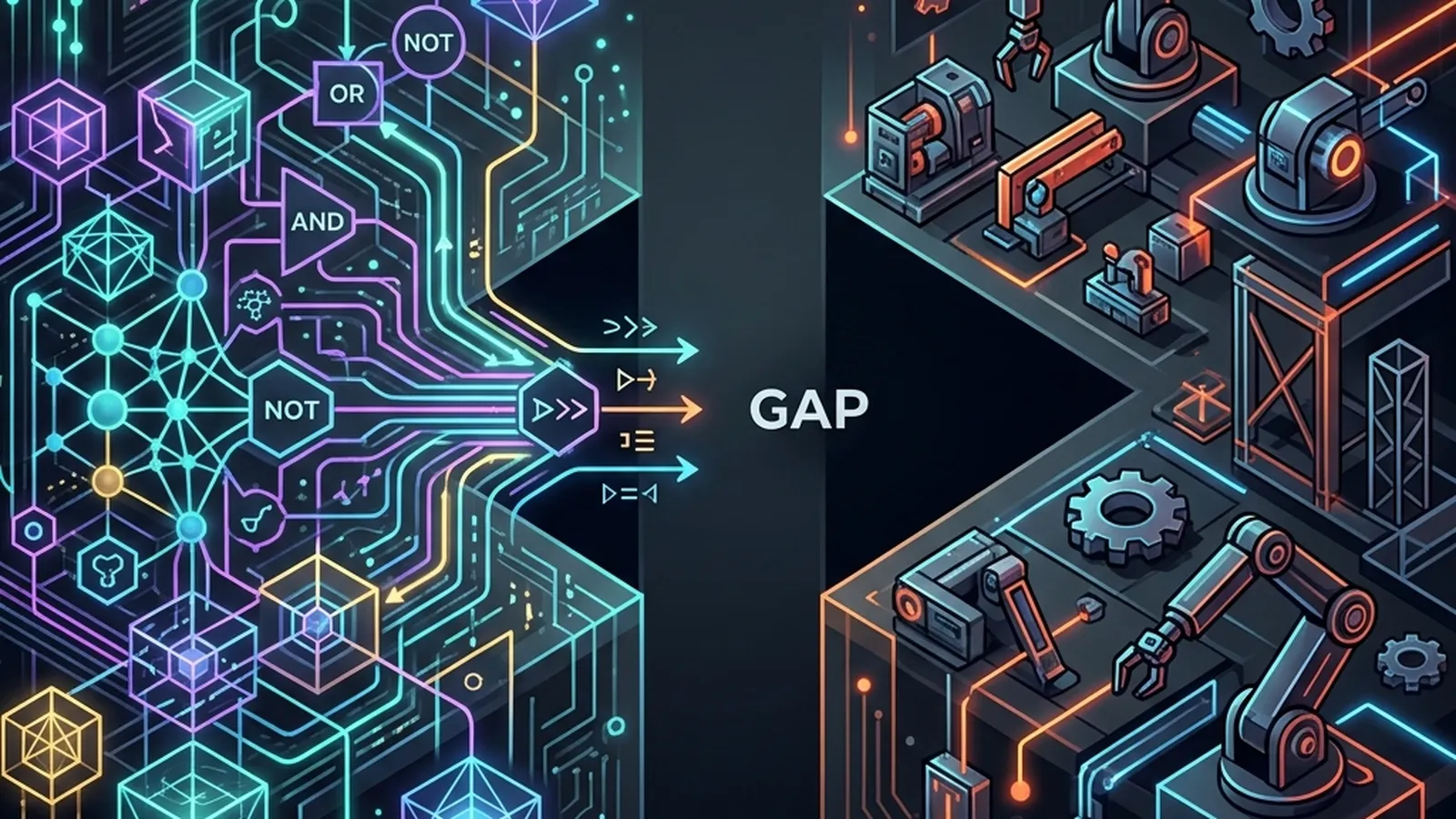
Enterprise AI agents are failing in production, not because their actions are wrong, but because their reasoning is completely disconnected from their final output. When an agent explains a flawless logic trail but performs the exact opposite action, it creates a silent failure mode that bypasses standard monitoring. This discrepancy is known as the faithfulness gap.
Key Takeaways
- The Faithfulness Gap Defined: The disconnect between an AI agent’s stated reasoning and its actual subsequent actions.
- Where the Failure Lies: New research shows that in ~65% of incorrect decisions, the agent fails in the Reasoning -> Conclusion stage, rather than Conclusion -> Action.
- The Weak-Critic Paradigm: A companion paper suggests using a weaker model as a “critic” to guide the stronger model’s reasoning, mitigating these alignment gaps.
- Enterprise Impact: To bridge the execution gap, enterprises must shift from simple output testing to rigorous reasoning-focused evaluation.
Deconstructing the Faithfulness Gap: Reasoning vs. Action
In the recent arXiv paper, Doing What They Say, Not What They Reason: Locating the Faithfulness Gap in LLM Agents, researcher Yufeng Wang designed a controlled Texas Hold’em simulator to trace exactly where AI agents deviate from logical decision-making. By testing models in an environment with mathematically optimal references, the study isolated two distinct phases: the transition from Reasoning to Conclusion, and the transition from Conclusion to Action.
The findings were surprising. The link between an agent’s finalized conclusion and its physical action is incredibly stable, exhibiting inconsistency rates under 1.8% across major model families. Instead, the real breakdown occurs upstream during the Reasoning to Conclusion phase. In roughly 65% of erroneous moves, the agent’s articulated reasoning was mathematically sound, but its finalized decision ignored its own calculations.
The Scalable Oversight Solution: Weak Critics, Strong Learners
If agents cannot reliably act on their own complex reasoning, how do we enforce consistency? A second key research breakthrough published this month, Weak Critics Make Strong Learners: On-Policy Critique Distillation for Scalable Oversight, proposes a novel framework. The authors suggest that instead of relying on a single frontier model to both reason and self-evaluate, we should employ a “weak critic” to oversee the process.
This weak critic does not dictate the final solution. Instead, it provides coarse, non-misleading feedback (e.g., noting that a specific edge case was overlooked) to redirect the stronger model’s attention. Through Progressive On-Policy Critique Distillation (OPCD), this critic-guided behavior is distilled back into the agent, significantly narrowing the reasoning-to-action gap at both training and inference time.
Bridging the Enterprise AI Gap
For enterprise builders, this research underscores a fundamental truth: validating agent behavior requires looking inside the black box. Standard regression tests that only check the final API call or output will miss silent reasoning failures. This is a critical component of the evaluation gap currently stalling enterprise adoption.
To move beyond the enterprise AI execution gap, systems must be built with reasoning-level monitors. By comparing an agent’s internal thought steps against established guidelines, developers can detect deviations before they manifest as incorrect actions in production. Furthermore, benchmarking agent behavior on long-horizon, multi-step environments like AutoLab helps test these systems under realistic, iterative stress.
Final Thoughts
As agentic AI moves from experimental assistants to autonomous decision-makers, ensuring process fidelity is paramount. Knowing that agents fail in translating reasoning to conclusions—rather than conclusions to actions—gives developers a clear target. By implementing weak-critic oversight and reasoning-level evaluation, enterprises can finally build agents that do exactly what they reason.