The End of SaaS: Why AI Agents Are the New Operating System

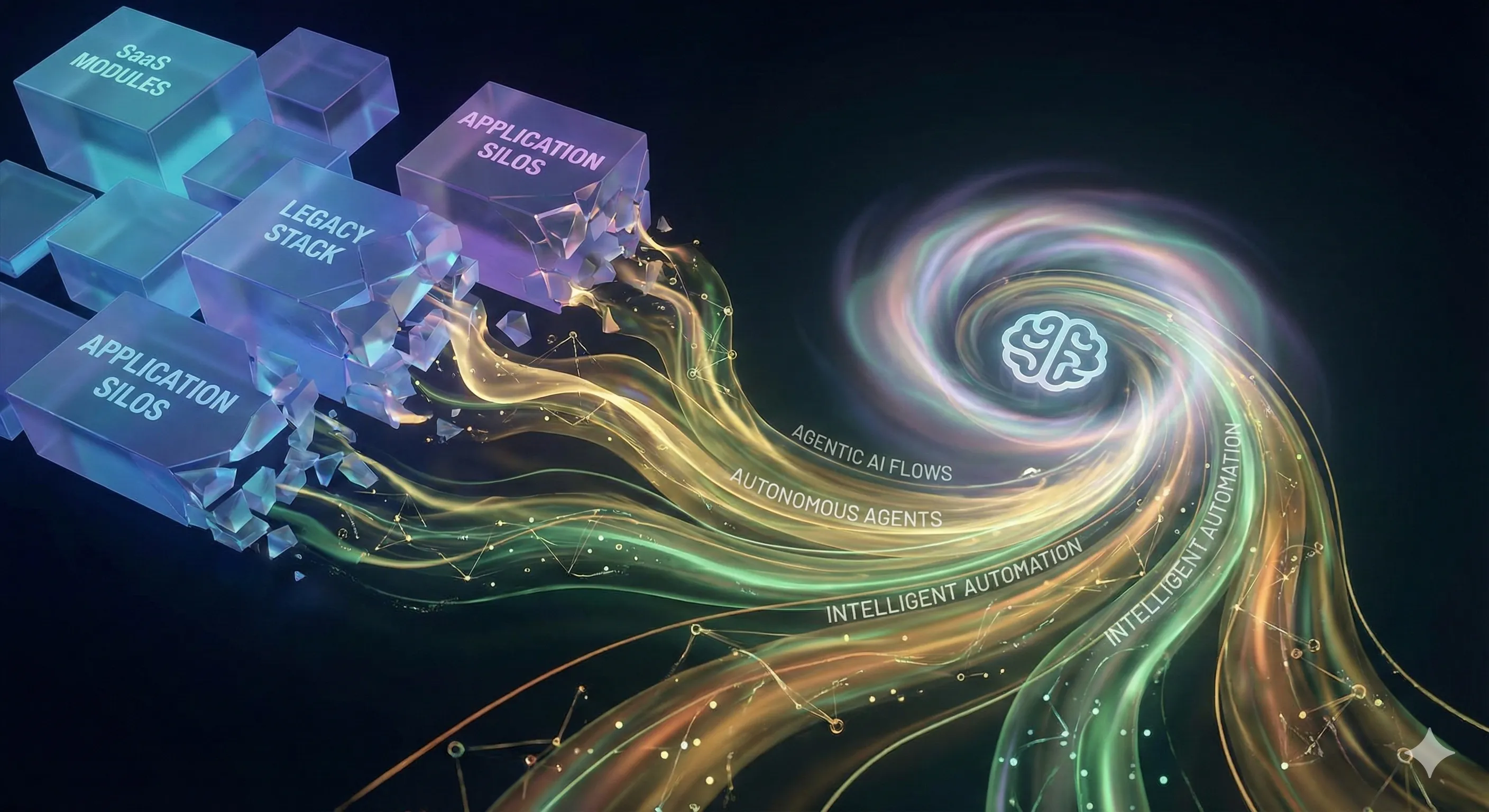
For the last decade, “Software as a Service” (SaaS) was the gold standard of enterprise efficiency; today, it’s becoming the bottleneck. We are witnessing a fundamental shift where applications are no longer destinations we visit, but tools that autonomous agents wield on our behalf.
Key Takeaways
- SaaS Sprawl is the New Legacy Debt: The average enterprise uses hundreds of disjointed apps, creating data silos that slow down decision-making.
- Agents as the Control Plane: AI agents are emerging as the connecting layer that orchestrates work across these siloed applications.
- Outcome-Based Economy: The business model is shifting from paying for “seats” (access) to paying for “work done” (outcomes).
The Fragmentation Crisis
In the 2010s, the explosion of SaaS solved the problem of on-premise software deployment. But it introduced a new problem: fragmentation. Data lives in Salesforce, communication in Slack, documentation in Notion, and code in GitHub. Humans act as the “glue API,” manually copying and pasting context between these systems.
This inefficiency is exactly what an Agentic Control Plane aims to solve. Instead of you navigating ten different UIs to complete a procurement workflow, an agent simply executes the task across all of them via API.
From Software-as-a-Service to Service-as-Software
The venture capital firm Sequoia Capital has described this shift as moving toward “Service-as-Software.” In this new paradigm, you don’t buy a CRM to manage your customers; you hire an AI agent to manage the CRM for you.
We are already seeing this in specific verticals. For instance, autonomous procurement systems are replacing the traditional RFP process. The software interface fades into the background, relevant only for audit logs and exception handling, while the agent handles the bulk of the operations.
The Economic Implications
This shift poses an existential threat to the traditional seat-based pricing model. If an AI agent can do the work of ten junior analysts using a single software license, the economics of SaaS collapse.
Furthermore, with the DeepSeek cost revolution, the cost of intelligence is plummeting. This allows enterprises to deploy thousands of specialized micro-agents for pennies, creating a workforce that scales infinitely without the overhead of traditional software licensing fees.
Final Thoughts
The era of logging into a dashboard to view a pie chart is ending. The future belongs to organizations that build the infrastructure for agents to observe, reason, and act. We are not just adopting new software; we are adopting a new operating system for business itself.
The question for 2026 isn’t “Which software should we buy?” but “Which agents should we hire?”
Sources: