Grok Goes to War: xAI's Pentagon Deal Changes Everything


The line between Silicon Valley and the Pentagon just got dramatically thinner—and Elon Musk drew it himself.
Key Takeaways
- Historic Contract: xAI’s Grok has been officially cleared to operate inside highly classified U.S. military systems under the Pentagon’s “all lawful use” standard.
- No Guardrails, By Design: Unlike Anthropic, xAI accepted terms that remove typical ethical restrictions on AI outputs, giving the military far broader operational latitude.
- Competitive Fallout: Anthropic reportedly declined similar terms, drawing a sharp dividing line between “mission-critical” AI and “responsible” AI.
- The Governance Question: Who decides what “lawful use” means when the system is classified and the AI is running it?
The Deal: What We Know
Axios broke the story this week: xAI has formally agreed to deploy its Grok model within U.S. Department of Defense classified systems, operating under a standard known as “all lawful use.” This is not a pilot program or a proof-of-concept. This is a live deployment inside sensitive military infrastructure.
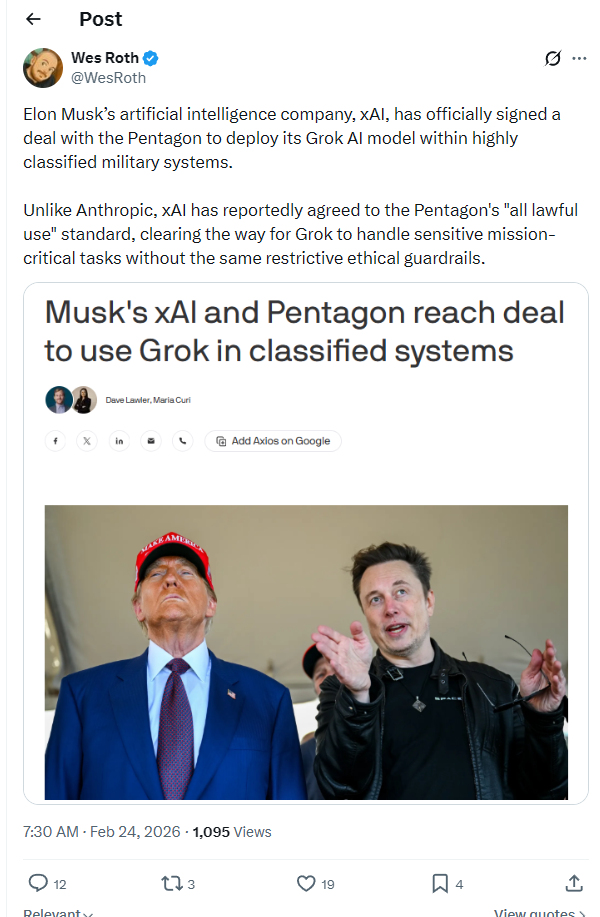
The implications are massive. Grok will reportedly be used for mission-critical analysis tasks—the kind that previously required teams of cleared analysts with years of specialized training.
The “All Lawful Use” Clause: A Critical Wedge
This is the detail that separates the xAI deal from every other enterprise AI contract on the market.
Most frontier AI companies—Anthropic chief among them—limit military and government contracts with what the industry calls “responsible use” clauses. These impose constitutional guardrails: no outputs that could facilitate mass-casualty weapons, no manipulation of democratic processes, no content that bypasses established legal oversight structures.
The Pentagon’s “all lawful use” standard operates on a different logic. If it’s legal under U.S. law and authorized by command, the AI executes the task. End of discussion.
Anthropic reportedly declined to sign on these terms. As we covered in our deep dive on Anthropic’s battle to protect Claude from distillation attacks, the company has staked its entire identity on safety-first development. Accepting “all lawful use” terms would fundamentally contradict that position.
xAI, by contrast, took the contract.
Why This Matters for Enterprise AI Governance
If you run an enterprise AI program, this deal should be a wake-up call—not because of the military implications specifically, but because of what it signals about market bifurcation.
We are entering an era where AI vendors are being forced to choose a lane:
- Mission-Critical AI – High capability, broad permissions, deployed inside classified or high-stakes environments where restraint is seen as a liability.
- Responsible AI – Guardrailed, auditable, built for regulated industries where safety certifications matter more than raw performance.
The problem is that most enterprises don’t operate in either pure environment. They need both. And as this Pentagon deal shows, the vendors building for each lane are increasingly incompatible with each other.
This is precisely the tension we explored in our breakdown of why 2026 demands a new AI agent governance framework—the question is no longer just what AI can do, but who controls what it’s allowed to do.
The Ethical Guardrails Debate: Both Sides Are Right
It’s tempting to frame this as a simple binary: Anthropic = responsible, xAI = reckless. The reality is more nuanced.
Military systems do require capabilities that consumer-grade safety filters would block. Target identification, adversarial intelligence analysis, electronic warfare support—these are legitimate national security functions that require AI without flinching.
The real question is whether “all lawful use” is a sufficiently robust standard when the system is classified, the outputs are secret, and the AI is making consequential decisions at machine speed.
As Wired reported on autonomous weapons policy, the U.S. military’s existing oversight doctrine for autonomous lethal systems was written before large language models existed. Grok is operating in a governance vacuum.
What This Signals for the Broader AI Market
The xAI Pentagon contract is a proof point for something those of us watching the AI governance landscape have long anticipated: geopolitical pressure will eventually force every frontier AI lab to pick a side.
The companies that delay this decision—that try to serve both regulated enterprise clients and defense contracts—will face increasing pressure from both directions. Government clients will demand more capability and fewer restrictions. Enterprise compliance officers will demand tighter controls and full auditability.
You cannot optimize for both simultaneously. The xAI deal just made that explicit.
Final Thoughts
Grok inside Pentagon classified systems is not the end of a debate—it’s the beginning of one that will define the next decade of AI development.
The questions that matter now are operational: Is “all lawful use” a meaningful constraint? Who audits the outputs of a classified AI deployment? And what happens when Grok gets something catastrophically wrong inside a system no one outside the DoD can examine?
The military doesn’t publish its AI incident reports. That opacity, combined with the speed and scale of modern AI systems, is the real governance risk here—not whether Elon Musk’s politics align with your preferences.
For organizations building AI programs today, the lesson is clear: get your governance architecture right before you need it. Because once your AI is embedded in a system that matters, the window for “we’ll figure it out later” closes permanently.
Interested in how to build AI governance that holds under real-world pressure? Explore our guide to AI-powered autonomous defense strategies for a technical grounding in what responsible AI deployment actually looks like.
More from our Blog

The Hidden War for AI Intelligence: Inside the 13-Million Distillation Attack on Anthropic's Claude

Meta Joins NVIDIA to Build the Future of AI Infrastructure