The Last Invention: When AI Completes the Recursive Loop


The Last Invention: When AI Completes the Recursive Loop
Imagine an AI that writes better code than its creator. Now imagine it doing that 1,000 times per second.
In 1965, mathematician I.J. Good speculated that an “ultra-intelligent machine” could design even better machines, leading to an “intelligence explosion” that would leave human intellect far behind. He called this the “last invention that man need ever make.”
For decades, this concept of Recursive Self-Improvement (RSI) was purely theoretical—the stuff of sci-fi novels and academic papers. But in 2026, as we watch autonomous agents debug their own kernels and optimize their own weights, the theory is becoming an engineering problem.
Key Takeaways
- RSI is the engine of the Singularity: It occurs when an AI system improves its own intelligence, leading to a feedback loop of exponential growth.
- We are seeing the precursors: Current coding agents can identify bugs and propose fixes in their own logic, a primitive form of self-modification.
- Speed is the differentiator: Silicon operates at speeds biological neurons can't match, meaning centuries of "evolution" can happen in minutes.
The Architecture of Ascension
The core mechanism of RSI is a closed feedback loop. Currently, AI development is linear: humans write code, train a model, evaluate it, and then write better code for the next version. RSI closes this loop by removing the human bottleneck.
When an AI can not only write code but understand the architecture of its own intelligence, it can propose hypotheses for improvement that no human could conceive. This isn’t just about efficiency; it’s about structural evolution. We’ve seen hints of this in evolutionary algorithms, where systems discover novel architectures through trial and error.
Signals from the Noise
This isn’t happening in a vacuum. The rise of agentic AI has given us systems that can pursue long-horizon goals. When that goal is “optimize my own inference latency” or “rewrite my memory retrieval function,” the agent enters a micro-loop of self-improvement.
We are already seeing the community react to these early signals. High-profile researchers are noting that the gap between “tool user” and “tool maker” is closing fast.
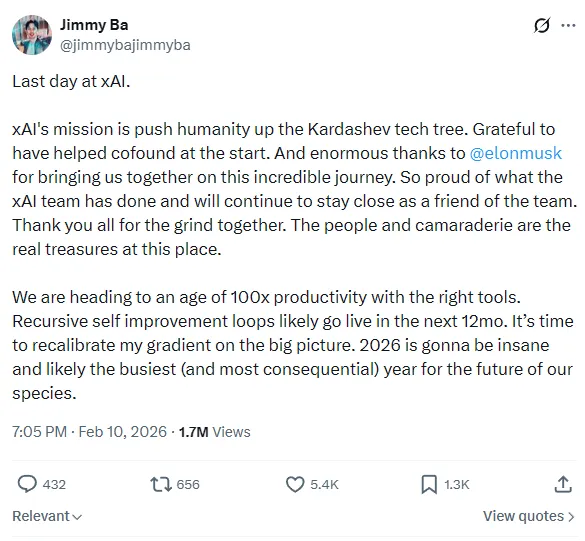
The conversation around RSI is shifting from "if" to "how fast."
This tweet highlights a critical sentiment: the recursive loop isn’t just about raw compute; it’s about the quality of the self-modification. A system that improves its own ability to learn is far more dangerous—and promising—than one that just gets faster.
Visualizing the Intelligence Explosion
To understand what this looks like structurally, we can look at accelerated reinforcement learning. In RL, an agent explores an environment, receives rewards, and updates its policy. In RSI, the “environment” is the agent’s own code, and the “reward” is increased intelligence.
The visual representation of this learning process is often chaotic, fast, and alien. It moves through failure modes at lightning speed to find optimal paths.
Reinforcement learning agents navigating complex environments—a microcosm of the recursive loop.
While this video shows a physical simulation, imagine the same frenetic, high-speed iteration applied to cognitive architectures. The “agent” isn’t learning to walk; it’s learning to think. And just like the figure in the video stabilizes and masters its environment, an RSI system eventually stabilizes at a level of competency that defines its new baseline.
Living in the Exponential
The implications for business are profound. If your competitor deploys a system capable of even limited recursive improvement, their operational efficiency won’t just improve linearly—it will compound. This is why your company’s AI strategy needs to move beyond static models to dynamic, learning systems.
We are standing on the precipice of a new era. The loop is closing. The only question remaining is: are we ready for what comes out the other side?