AI Healthcare Diagnostics: 2025 Imaging Breakthrough

The Diagnostic Revolution: AI’s Transformative Impact on Healthcare
The landscape of healthcare diagnostics is undergoing a seismic shift in 2025, driven by unprecedented advances in artificial intelligence. What was once the domain of highly specialized radiologists and pathologists is now being augmented—and in some cases surpassed—by AI systems that can detect diseases with superhuman accuracy, often before symptoms even appear.
This transformation isn’t just about speed or efficiency; it’s about fundamentally changing how we understand, detect, and treat disease. In hospitals and clinics around the world, AI-powered diagnostic tools are enabling earlier interventions, reducing diagnostic errors, and making high-quality healthcare more accessible to underserved populations.
The Power of AI-Enhanced Medical Imaging
Beyond Human Perception
Traditional medical imaging has always been limited by human perception. Radiologists, no matter how skilled, can only process so much visual information in a given time frame. AI systems, however, can analyze thousands of images per second, detecting subtle patterns that might escape even the most experienced human eye.
In 2025, we’re seeing AI systems that can:
- Detect micro-calcifications in mammograms that are invisible to human radiologists
- Identify early-stage lung nodules in CT scans with 95% accuracy
- Analyze retinal images to detect signs of diabetes, hypertension, and even Alzheimer’s disease
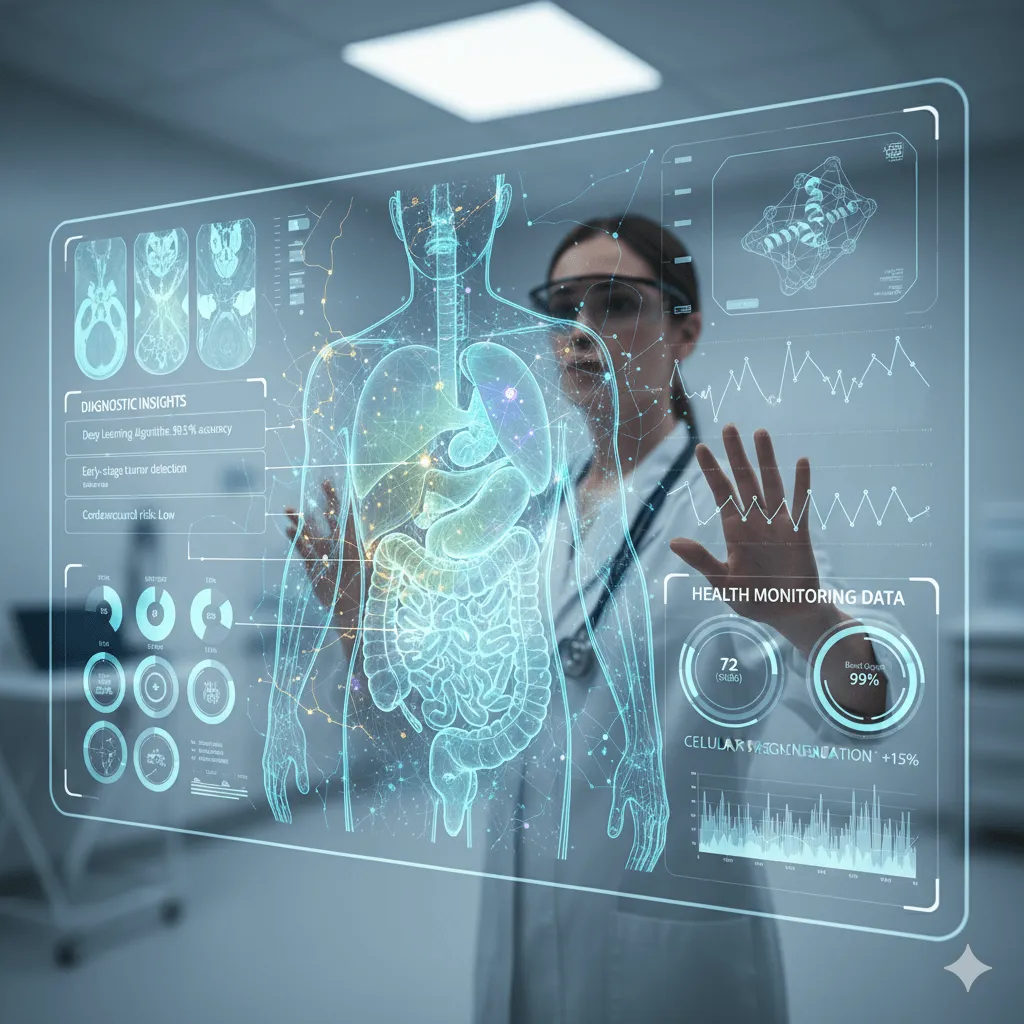
- Process multi-modal imaging combining MRI, CT, and PET scans for comprehensive diagnostic insights
Real-Time Analysis and Decision Support
One of the most significant breakthroughs in 2025 is the integration of AI directly into imaging equipment. Modern MRI and CT scanners now come equipped with AI coprocessors that can provide real-time analysis during the scanning process. This means radiologists receive preliminary diagnostic suggestions while the patient is still in the machine, dramatically reducing turnaround times for critical diagnoses.
Early Detection: Catching Disease Before It Starts
Predictive Diagnostics
The true promise of AI in healthcare diagnostics lies not just in analyzing existing conditions, but in predicting them before they manifest. In 2025, AI systems are being deployed that can:
- Analyze biomarkers in blood tests to predict the likelihood of developing certain cancers years in advance
- Monitor gait and movement patterns through smartphone sensors to detect early signs of Parkinson’s disease
- Analyze voice patterns to identify neurological conditions like ALS before traditional symptoms appear
- Process genetic data to identify predispositions to rare diseases that might otherwise go undiagnosed for years
Population Health Screening
AI-powered diagnostic tools are making large-scale health screening more feasible and cost-effective. Mobile health units equipped with AI diagnostic systems can now travel to remote areas, providing sophisticated diagnostic capabilities that were previously only available in major medical centers. This is particularly impactful for conditions like diabetic retinopathy, where early detection can prevent blindness but requires specialized expertise that’s often unavailable in rural areas.
Personalized Medicine: Tailoring Treatment to the Individual
Precision Diagnostics
The integration of AI with genomics and proteomics is enabling a new era of precision diagnostics. Rather than relying on population averages, AI systems can now analyze individual patient data to provide highly personalized diagnostic insights. This includes:
- Pharmacogenomic analysis to predict how individual patients will respond to specific medications
- Tumor profiling that can identify the most effective treatment protocols for individual cancer patients
- Risk stratification that can identify which patients are most likely to benefit from aggressive interventions versus conservative management
Treatment Recommendation Systems
Advanced AI diagnostic platforms now go beyond simply identifying conditions—they provide evidence-based treatment recommendations tailored to individual patients. These systems can analyze vast databases of medical literature, clinical trial results, and patient outcomes to suggest the most effective treatment approaches for specific patient profiles.
Overcoming Traditional Diagnostic Challenges
Reducing Diagnostic Errors
Medical diagnostic errors are a leading cause of patient harm, with studies suggesting that up to 12 million Americans experience diagnostic errors each year. AI systems can significantly reduce these errors by:
- Providing second opinions on complex cases
- Flagging unusual findings that might be overlooked
- Reducing fatigue-related errors during long reading sessions
- Standardizing interpretations across different healthcare providers
Addressing Healthcare Workforce Shortages
Many regions face critical shortages of radiologists and other diagnostic specialists. AI systems can help bridge this gap by handling routine cases, allowing human specialists to focus on the most complex and challenging diagnoses. This doesn’t replace human expertise but rather amplifies it, enabling healthcare systems to serve more patients with the same workforce.
Ethical Considerations and Implementation Challenges
Ensuring Equity and Access
As powerful as AI diagnostic tools are, there’s a risk that they could exacerbate existing healthcare disparities if not implemented thoughtfully. Key considerations include:
- Algorithm bias that might perform differently across different demographic groups
- Access limitations in resource-constrained settings
- Digital literacy requirements that might exclude certain patient populations
- Privacy and data security concerns with sensitive health information
Regulatory and Validation Requirements
The rapid advancement of AI diagnostic tools has outpaced regulatory frameworks in many jurisdictions. Ensuring that these tools are properly validated and regulated is crucial for maintaining patient safety while still enabling innovation. In 2025, we’re seeing:
- Real-world evidence requirements for AI diagnostic tools
- Continuous monitoring systems to track performance in clinical settings
- Interoperability standards to ensure AI tools work seamlessly with existing healthcare IT systems
The Road Ahead: Future Developments
Integration with Wearable Technology
The convergence of AI diagnostics with wearable health monitoring devices is creating new opportunities for continuous health assessment. Smartwatches and fitness trackers equipped with advanced sensors can now collect data that, when analyzed by AI systems, can provide early warnings of potential health issues.
Federated Learning for Improved Accuracy
One of the most promising developments in 2025 is the use of federated learning to train AI diagnostic models. This approach allows models to be trained on data from multiple institutions without actually sharing patient data, leading to more robust and generalizable diagnostic tools while preserving patient privacy.
Explainable AI for Clinical Trust
As AI diagnostic systems become more sophisticated, there’s a growing emphasis on making their decision-making processes transparent and understandable to healthcare providers. Explainable AI techniques are helping clinicians understand why a system reached a particular diagnosis, building trust and facilitating better clinical decision-making.
Conclusion
The integration of AI into healthcare diagnostics represents one of the most significant advances in medical technology in recent history. In 2025, we’re witnessing AI systems that can detect diseases earlier, more accurately, and more consistently than ever before. These tools are not replacing human healthcare providers but rather empowering them to deliver better care to more patients.
As we continue to refine these technologies and address the associated challenges, the potential for AI to transform healthcare diagnostics—and ultimately improve patient outcomes—is immense. The future of medicine is here, and it’s powered by artificial intelligence.